Choosing a reliable Food Vacuum Bag supplier is not simply a price comparison. It is a practical decision about product safety, shelf life, machinery compatibility, and delivery consistency. Global buyers must examine film structure, seal strength, oxygen transmission, moisture resistance, and temperature performance before placing large orders.
Dr. Aaron L. Brody, a respected food-packaging consultant, has said, “Packaging is the silent salesperson.” That idea remains useful here. A well-made bag protects frozen seafood, fresh meat, cheese, coffee, and prepared meals while presenting a clean, trustworthy appearance. A weak seal can quietly damage an entire shipment.
This guide reviews ten Food Vacuum Bag suppliers serving international buyers. It considers manufacturing experience, material options, quality-control systems, certifications, customization, minimum order quantities, and export support. Samples matter. So do factory audits and test reports.
Not every supplier performs equally well.
Some companies offer attractive quotations but limited technical guidance. Others provide excellent film quality but slower production schedules. Buyers should also confirm whether bags fit chamber machines, external suction machines, or automatic packaging lines. Thickness alone does not guarantee performance. A 90-micron bag may suit one product, while sharp frozen bones require stronger puncture resistance.
The ranking is therefore not based on marketing claims alone. It reflects practical buying concerns and publicly available supplier information. Details can change, and supplier performance may vary by region or order size. That uncertainty deserves attention. Use this overview as a screening tool, then verify specifications directly before signing a contract.
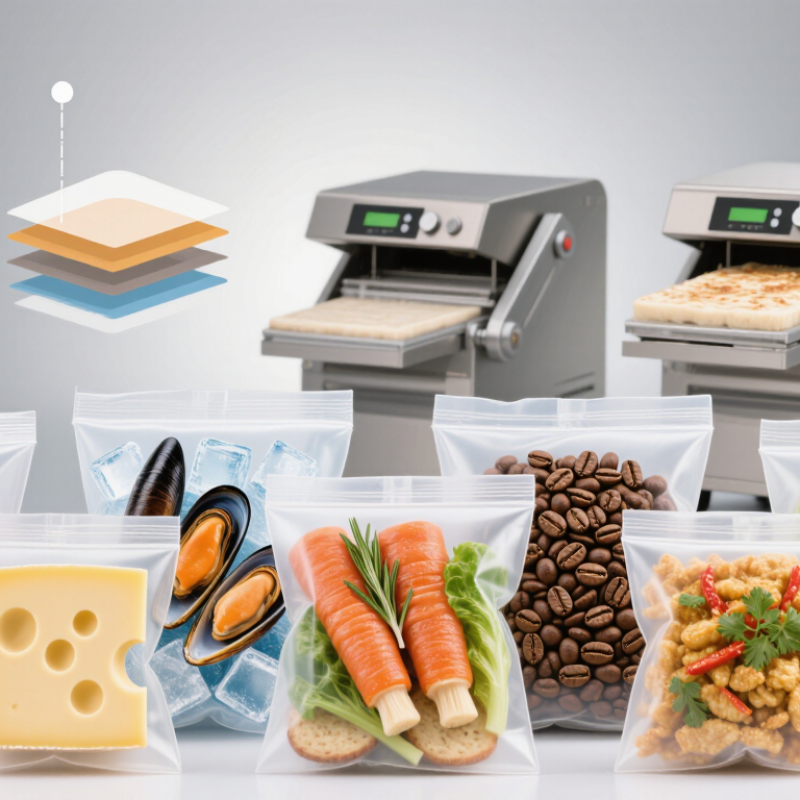
A reliable food vacuum bag supplier proves performance before discussing price. Buyers should request oxygen transmission rate, water vapor transmission rate, and seal-strength data for every structure. These figures matter because meat, seafood, and cheese respond differently to oxygen and moisture. A supplier should also provide food-contact compliance documents, batch traceability, and migration testing from qualified laboratories. ISO 22000-based food safety systems add useful control, but certification alone cannot guarantee consistent bag quality.
The 2024 UNEP Food Waste Index Report estimates that 1.05 billion tonnes of food were wasted in 2022. Packaging cannot solve every cause, yet stronger seals and suitable barrier layers can reduce avoidable spoilage during storage and transport. Reliable suppliers should explain how their bags perform after freezing, heating, puncturing, and repeated handling. Ask for samples from different production lots. Check the seal at the corners, not only across the flat surface.
Small details matter.
A dependable supplier also shares realistic lead times, minimum order quantities, and corrective-action records. Their technical team should answer questions with test evidence, not vague claims. Still, no bag is perfect. A material that performs well for frozen poultry may fail with oily foods or sharp bones. Buyers should run their own shelf-life trials under actual conditions. This step is often skipped, and that is an expensive weakness. Suppliers worth trusting welcome these tests, document changes, and admit where their product needs improvement.
A practical supplier evaluation benchmark based on food-contact compliance, packaging performance, production capability, and export readiness.
| No. | Supplier Evaluation Dimension | Reliable Supplier Benchmark | Relevant Specification or Standard | Buyer Verification Point |
|---|---|---|---|---|
| 1 | Food-Contact Compliance | Provides a current declaration of compliance and supporting migration-test documentation for every material structure. | EU Framework Regulation 1935/2004; EU Plastics Regulation 10/2011; applicable FDA food-contact requirements. | Check whether documents cover the exact film layers, inks, adhesives, intended food type, temperature, and contact time. |
| 2 | Food-Safety Management | Maintains documented hygiene controls, hazard analysis, sanitation procedures, and batch traceability. | HACCP-based controls; ISO 22000 or an equivalent certified food-safety management system. | Request a valid certificate, audit scope, issuing body, expiry date, and the production site covered. |
| 3 | Barrier Film Structure | Uses a fit-for-purpose multilayer structure, commonly polyamide for mechanical strength and polyethylene for heat sealing. | Typical structure: PA/PE or equivalent coextruded or laminated food-contact film. | Confirm layer order, total thickness, sealant type, recyclability position, and compatibility with the vacuum machine. |
| 4 | Film Thickness and Consistency | Offers repeatable thickness across the roll or bag, with a documented tolerance and inspection method. | Common commercial thickness range: approximately 70–150 micrometres, depending on application. | Compare measured samples with the approved specification and request thickness inspection records. |
| 5 | Vacuum and Seal Performance | Produces bags that maintain a continuous seal without channels, wrinkles, delamination, or leakage after vacuuming. | Seal strength is commonly evaluated using ASTM F88/F88M or an equivalent test method. | Conduct vacuum-hold, leak, burst, and seal-strength tests using the buyer’s actual equipment and settings. |
| 6 | Puncture and Abrasion Resistance | Matches film strength to the product, especially for meat bones, seafood shells, frozen food, and products with sharp edges. | Puncture resistance may be assessed using ASTM F1306 or a comparable laboratory method. | Test both refrigerated and frozen products, because low temperatures can change film flexibility and impact resistance. |
| 7 | Oxygen and Moisture Barrier | Supplies barrier performance appropriate for the required shelf life, oxidation sensitivity, and storage conditions. | OTR and WVTR should be reported with test temperature, humidity, units, and test method. | Do not compare barrier values unless the laboratory conditions and measurement methods are the same. |
| 8 | Dimensional and Printing Control | Controls bag width, length, gusset, notch position, print registration, and seal placement through documented inspections. | Tolerance must be agreed in the purchase specification; a common commercial starting point is about ±2–3 mm for bag dimensions. | Approve a signed pre-production sample and verify artwork, barcode readability, colors, and mandatory labeling. |
| 9 | Production and Quality Capacity | Has controlled extrusion, printing, lamination, bag-making, inspection, and packing processes at the same declared facility. | Quality plan should include incoming-material checks, in-process inspections, final sampling, and nonconformity handling. | Ask for production-flow photographs, capacity information, inspection plans, and recent anonymized test reports. |
| 10 | Export Readiness and Traceability | Provides clear commercial terms, export packaging, lot identification, certificates of analysis, and a defined corrective-action process. | Each shipment should be traceable to raw-material lots, production dates, inspection results, and shipping documents. | Confirm lead time, minimum order quantity, Incoterms, carton specifications, palletization, and replacement policy before ordering. |
Note: Thickness ranges, tolerances, testing conditions, minimum order quantities, and delivery schedules vary by application and supplier. Final specifications should be confirmed through product samples, technical data sheets, compliance documents, and independent testing where required.
For international buyers, the top ten food vacuum bag suppliers should offer dependable materials, stable production, and clear export support. A practical review should examine nylon and polyethylene layers, seal strength, puncture resistance, and oxygen protection. These details matter when bags travel through humid ports, cold warehouses, and busy kitchens.
Reliable suppliers usually provide food-contact documentation, batch traceability, and samples before large orders. Ask for thickness options, roll or pouch formats, printing limits, minimum order quantities, and lead times.
A strong supplier can explain how its bags perform with oily foods, sharp bones, or frozen products. It should also describe storage conditions clearly. Good answers build trust.
Cost still influences every buying decision. However, the cheapest bag may create leaks, waste, and customer complaints. Request test data for seal temperature, tensile strength, and vacuum retention. A small trial order can reveal more than a polished catalog. No supplier is perfect. Some offer excellent film quality but slower communication, while others respond quickly but provide fewer customization choices. International buyers should record these weaknesses, not ignore them. The best choice combines verified performance, responsive service, realistic shipping schedules, and consistent quality across repeated orders.
Global buyers need more than a low quoted price when selecting food vacuum bags. Grand View Research estimates the global vacuum packaging market will expand steadily through 2030, driven by fresh food, frozen products, and longer distribution routes. Common product types include embossed rolls, smooth chamber pouches, shrink bags, and boilable bags. External machines often require textured material, while chamber machines usually perform better with smooth films.
Material selection affects protection, sealing, and recyclability. A typical PA/PE structure combines puncture resistance with reliable heat sealing. High-barrier films may add EVOH for oxygen protection, especially for meat, cheese, and roasted foods. Mono-PE options can simplify recycling, but they may sacrifice stiffness or barrier performance. The UNEP Food Waste Index Report 2024 estimated 1.05 billion tonnes of food were wasted in 2022. Better packaging cannot solve waste alone, yet stronger seals and suitable barriers can reduce avoidable spoilage.
Size and customization should follow the product, not a supplier’s standard chart. Buyers should specify length, width, gusset depth, film thickness, seal width, and filling weight. Small bags suit portions; larger formats need stronger corners and controlled vacuum pressure. Custom printing, rounded corners, tear notches, hanging holes, and private measurements are widely available. Ask for oxygen transmission, water vapor transmission, and seal-strength test data. ASTM F88 and ASTM D3985 methods offer useful comparison points. A perfect specification is rare. In practice, I would test filled samples through freezing, transport, sealing, and opening. That step often exposes weak seals or excessive material better than a polished quotation.
Indicative commercial specifications for commonly sourced food vacuum packaging formats. Values represent typical midpoint thicknesses in microns and are not tied to any supplier or brand.
Thicker structures generally provide greater puncture resistance for bone-in meat and retort applications, while thinner films are commonly used for lightweight food storage and sous vide packaging. Final specifications may vary by food type, sealing equipment, barrier requirements, and customization needs.
Selecting food vacuum bag suppliers requires more than comparing quotations. Material safety comes first. Buyers should request food-contact declarations, migration test reports, and traceability records for every production batch. ISO 22000 or HACCP-based controls show stronger process discipline. BRCGS certification can add useful evidence, but certificates must match the actual factory and product scope.
Performance data deserves equal attention. Smithers’ food packaging research highlights rising demand for longer shelf life and reduced food waste. The FAO reports that 13.2% of food is lost between harvest and retail. Vacuum bags cannot solve every loss, but oxygen transmission rate, water vapor transmission, puncture resistance, and seal strength directly affect storage results. Ask for test conditions, not only attractive figures. A thick bag is not automatically a better bag.
Pricing usually depends on resin type, barrier layers, printing, thickness, dimensions, and order quantity. Request three cost levels: trial quantity, standard production, and annual volume. Minimum orders may range from several thousand bags to hundreds of thousands, depending on customization and equipment setup. Confirm tooling charges separately. A low quote can be misleading. I have seen buyers overlook freight, testing, and rejected-roll costs. That mistake can erase the original saving. For a reliable comparison, require samples from the proposed production line, a written specification, delivery tolerance, and corrective-action procedures. One overlooked detail matters: sealing performance after refrigeration, freezing, and rough transport.
Choosing among food vacuum bag suppliers requires more than comparing unit prices. A low quote may hide thin film, weak seals, or unstable delivery schedules. Check the bag’s thickness, oxygen barrier, puncture resistance, and temperature range. Ask for samples that match your products, including bones, sauces, and oily foods. Then test them with your own vacuum equipment.
Your market also determines the right material structure. Frozen seafood may need stronger puncture resistance, while fresh produce needs suitable breathability. Confirm food-contact documentation, batch traceability, and quality inspection records. A dependable supplier should explain these details clearly, not simply promise premium quality. Request production samples before approving a large order.
Communication matters every week. Evaluate response speed, sample accuracy, minimum order quantities, and realistic lead times. Ask how they handle defective rolls, printing errors, and delayed shipments. A factory visit or third-party audit can reveal storage conditions and sealing practices. Small details matter.
I once focused too heavily on price. That decision caused extra waste during packing. A supplier may pass every document check but still perform poorly on a busy production line. Recheck seal strength after transport and freezer storage. Also compare the supplier’s capacity with your seasonal demand. A perfect sample means little if the next shipment changes. Your testing plan should remain practical, repeatable, and slightly skeptical.